


When people load an international website, stream a video recorded across the ocean or execute a cross-border financial transaction, they often assume the digital signal travels through satellites orbiting high above the atmosphere. The physical reality of the global internet is grounded in the deep ocean. More than 95 percent of international communications and data traffic moves through a dense web of submarine fiber-optic cables laid across ocean floors worldwide.
Today, approximately 500 commercial subsea cable systems span more than 1.4 million kilometers beneath the Atlantic, Pacific, Indian and Arctic oceans. These undersea networks carry petabits of data every second, linking continents, coastal hubs and landlocked regions through high-capacity digital pipelines. Without this subsea infrastructure, modern international commerce, cloud computing and global communication would immediately grind to a standstill.
The Physics of Undersea Optical Transmission
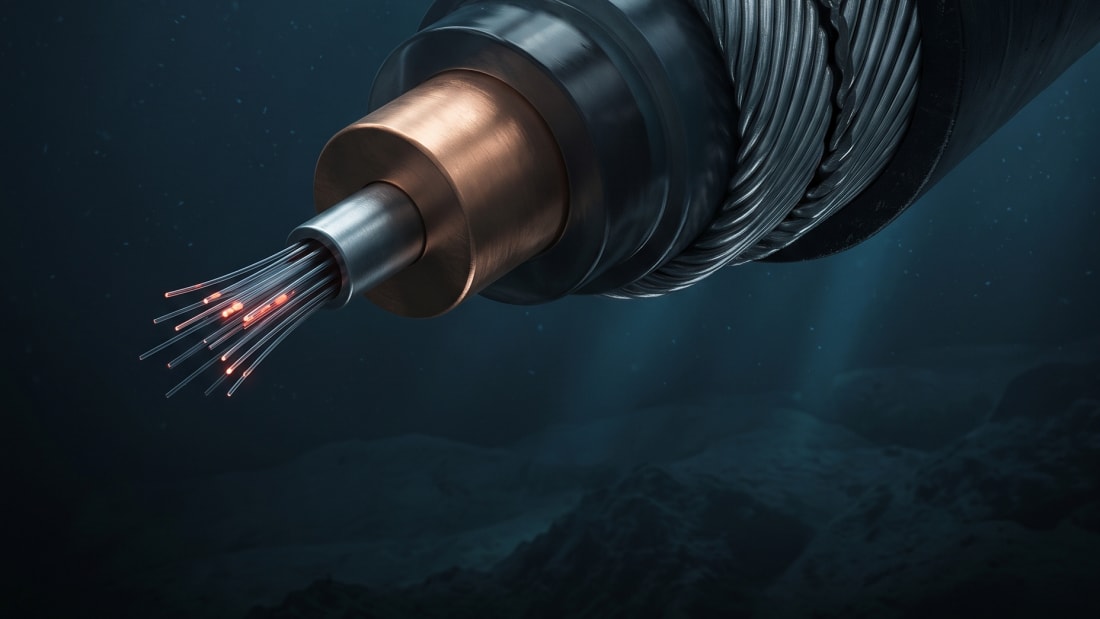
At the center of every modern submarine cable lies a bundle of hair-thin strands of ultra-pure silica glass called optical fibers. Unlike historical copper telegraph lines that transmitted electrical signals, modern subsea cables transmit digital information encoded as pulses of infrared laser light using total internal reflection.
To maximize capacity, telecommunications engineers deploy Dense Wavelength Division Multiplexing, widely known as DWDM. This technology splits laser light into dozens of distinct wavelengths, or colours, each carrying its own independent data stream along a single fiber strand. Recent advancements in spatial division multiplexing and coherent optical modulation now allow modern subsea cable pairs to achieve transfer rates surpassing 250 terabits per second, multiplying throughput across transoceanic distances.
Anatomy of an Undersea Cable: From Deep Waters to Coastlines
A widespread misconception is that submarine cables are massive, bulky conduits resembling subway tunnels. Across deep ocean plains, where water depths exceed several thousand meters, the cable is surprisingly compact. Measuring only 17 to 21 millimeters in diameter—roughly the thickness of a domestic garden hose—a deep-water cable relies on minimal exterior layers because it faces virtually no human interference on the calm seabed.
The construction shifts dramatically as the cable approaches shallow continental shelves, coastal waters and island shoals. In shallow zones under 1,500 meters, cables face severe physical hazards from commercial trawler nets, cargo anchors and turbulent wave currents. Here, engineers wrap the core in alternating layers of galvanized steel wire armor, waterproof petroleum jelly, tarred nylon yarn and a heavy high-density polyethylene outer jacket. These armored coastal variants can exceed 50 millimeters in diameter and weigh several kilograms per meter.
How Cable Ships Lay Lines Across Ocean Basins
Deploying thousands of kilometers of fragile optical fiber across uneven undersea mountain ranges and deep abyssal plains requires specialized engineering vessels known as cable-laying ships. These ships carry thousands of metric tons of coiled cable in internal storage tanks and utilize sophisticated dynamic positioning systems to navigate precise survey routes across oceans.
Before deployment begins, marine geologists map the seabed using multibeam sonar to locate underwater volcanoes, seismic faults, rocky outcrops and deep trenches. In coastal waters, the ship tows a heavy submersible sea-plow that cuts a trench along the seabed, lays the armored cable into the groove and covers it with marine sediment to protect it against vessel anchors. Once the vessel reaches deep water, the cable is carefully unspooled off the stern under strict tension controls, settling naturally onto the ocean floor.
Underwater Amplification and High-Voltage Power
Light pulses traveling through silica glass naturally lose intensity over long distances due to scattering and material absorption, a phenomenon known as optical attenuation. To prevent signals from fading into unreadable noise during transoceanic crossings, engineers place optical repeaters along the seabed every 50 to 80 kilometers.
These repeaters contain erbium-doped fiber amplifiers, or EDFAs. When excited by onboard pump lasers, erbium ions boost incoming light signals without having to convert the optical photons into electrical current first. To keep hundreds of underwater repeaters powered continuously across thousands of miles of ocean, a dedicated copper conductor surrounds the cable core, carrying direct electrical current of up to 10,000 volts supplied by high-voltage power feeding equipment located at onshore landing stations.
Cable Landing Stations: Where the Ocean Meets Terrestrial Grids
When a subsea cable approaches land, it enters a specialized shore facility known as a Cable Landing Station, or CLS. The landing station serves as the critical bridge connecting the submarine network to domestic terrestrial fiber systems and regional data centers.
Inside the landing station, terminal equipment separates the high-voltage electrical power from the optical data channels. The incoming signals are demultiplexed, checked for signal integrity and routed directly into national backbones. Countries strategically build multiple landing stations across different coastal locations to avoid single points of failure. In South Asia, international consortia networks such as SEA-ME-WE (South East Asia–Middle East–Western Europe) connect regional economies to global digital hubs in Singapore, Mumbai, Marseille and Dubai, providing crucial redundancy during localized outages.
Breakages, Anchor Strikes and Deep-Sea Repairs
Undersea cables suffer between 100 and 150 faults every year around the world. Contrary to popular folklore, shark attacks account for almost zero recorded outages. The International Cable Protection Committee reports that roughly two-thirds of all cable faults are caused by accidental human activity, primarily commercial fishing gear scraping the sea floor and dragging ship anchors.
Natural hazards also trigger significant outages. Subsea earthquakes, underwater landslides and turbidity currents can snap multiple cables simultaneously in seismically active corridors such as the Luzon Strait. When an outage occurs, network operators immediately reroute internet traffic through alternative cable paths using automated mesh routing protocols, preventing noticeable disruptions for end users.
Repairing a severed cable is a complex maritime operation. Specialized repair ships deploy specialized grapnels or remotely operated vehicles (ROVs) to locate and retrieve both ends of the severed cable from the seabed. Technicians lift the damaged sections into an onboard cleanroom, cut away degraded glass and manually fusion-splice optical fibers with microscopic precision before sealing the joint in a protective casing and lowering it back to the ocean floor.
The Shifting Economics of Subsea Infrastructure
Historically, submarine cable projects were financed and operated exclusively by traditional telecom consortia made up of state-owned carriers and multinational phone companies. Over the past decade, the economics of subsea connectivity have shifted dramatically toward private tech giants.
Major cloud and content hyperscalers—such as Google, Meta, Microsoft and Amazon—now own or fund substantial shares of global undersea cable capacity. Driven by surging data demands from artificial intelligence workloads, cloud computing and global video platforms, these private investments have dramatically accelerated bandwidth expansion while reshaping the governance of international digital infrastructure.
As digital connectivity becomes essential to national sovereignty and economic resilience, governments and operators worldwide are investing in diverse routing paths, enhanced marine monitoring and security safeguards. The quiet, invisible network of glass threads resting across the ocean floor remains the indispensable foundation of human society in the digital age.




Reader Discussion (0)
Join the Bangladeshist Community
Sign in with your Google account to post comments, reply to fellow readers, and engage in informed discussions.