


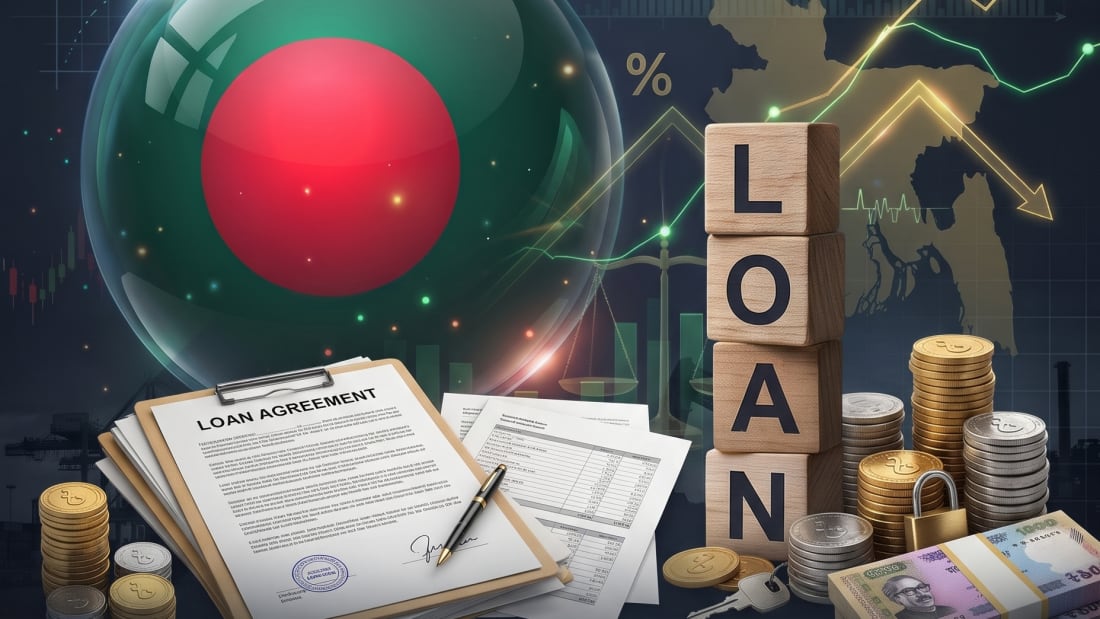
Bangladesh expects to complete negotiations with the International Monetary Fund (IMF) on a new loan programme by January or February 2027, as the government seeks to align the lender’s conditions with its economic priorities and development plans.
Finance and Planning Minister Amir Khosru Mahmud Chowdhury announced the timeline on November 15 while speaking to journalists after inaugurating the International Debt Conference Bangladesh 2026 in Cox’s Bazar.
He said two working groups, one representing Bangladesh and the other the IMF, were working to resolve differences over the proposed programme. The government does not intend to withdraw from its relationship with the IMF, but wants the financing arrangement and its conditions to reflect the country’s current economic circumstances.
The minister argued that some conditions attached to the previous programme had been negotiated under the former government and could not be implemented immediately without potentially placing additional pressure on households and businesses.
The government is seeking a gradual approach to reforms, with sufficient time to implement agreed measures. It also wants the IMF programme to complement development plans supported by the World Bank, Asian Development Bank (ADB) and Japan International Cooperation Agency (JICA).
Why Bangladesh wants a different approach
The negotiations come as Bangladesh faces growing pressure from external debt repayments and a decline in new foreign loan commitments.
According to provisional Economic Relations Division (ERD) data, Bangladesh repaid approximately $4.49 billion in principal and interest on foreign loans during the 2025–26 fiscal year, compared with $4.09 billion in the previous fiscal year.
Of the latest repayment total, $2.95 billion went towards principal and $1.54 billion towards interest.
Meanwhile, new foreign assistance commitments fell to approximately $5.24 billion in FY2025–26, down from $8.32 billion a year earlier. The figures indicate that the country is facing higher repayment obligations while securing less new financing from development partners.
This makes the terms, cost and timing of future financing particularly important for the government’s budget and development spending.
Existing IMF programme remains part of the picture
Bangladesh’s previous IMF programme was initially worth $4.7 billion when signed in January 2023. It was subsequently expanded to $5.5 billion.
The country received approximately $3.8 billion through five instalments, according to reporting by The Daily Star on November 12. The sixth tranche had been held up after discussions were suspended in November 2025, with negotiations expected to resume following the national election.
The new government’s approach is to negotiate an arrangement that better reflects its economic programme rather than simply continue with the previous conditions unchanged.
However, the finance minister’s latest announcement does not establish the size of a new IMF loan, its final conditions or the amount of financing Bangladesh may ultimately receive.
Debt management becomes a wider economic priority
The announcement coincided with Bangladesh’s first International Debt Conference, jointly organised by the Ministry of Finance and the ADB.
The two-day conference in Cox’s Bazar is bringing together policymakers, development partners and debt specialists to discuss borrowing costs, repayment risks and alternative financing sources.
The discussions are particularly significant as Bangladesh prepares for its revised least developed country (LDC) graduation timeline.
On October 29, the United Nations General Assembly approved a three-year extension of Bangladesh’s preparatory period, moving its scheduled graduation from November 2026 to November 24, 2029.
The additional time gives the country a longer period to prepare for the economic and trade adjustments associated with graduation. It does not, by itself, guarantee continued access to every existing concessional financing arrangement.
What happens next?
The immediate priority is to resolve differences between the government and the IMF through their respective working groups.
If the January–February 2027 target is met, the discussions could provide greater clarity on Bangladesh’s future financing arrangements and the pace of economic reforms.
The central question will be whether the government can secure a programme that supports economic stability while allowing sufficient flexibility for public investment, employment and social spending.
Until negotiations are completed, the proposed financing terms and the scale of any new IMF support remain uncertain.


Reader Discussion (0)
Join the Bangladeshist Community
Sign in with your Google account to post comments, reply to fellow readers, and engage in informed discussions.